Arizona Statutory Agent vs Registered Agent
Table of Contents
Understanding Arizona's Unique Terminology
The distinction between a statutory agent and a registered agent is, at its core, one of vocabulary rather than substance. Arizona stands apart from most of the country by codifying the role under the term "statutory agent" in A.R.S. § 29-3115, while the vast majority of states use "registered agent" or, less commonly, "resident agent." The underlying obligation is identical in every jurisdiction: a designated individual or entity must maintain a physical street address within the state and remain available during normal business hours to accept service of process on behalf of the business. The terminology difference traces back to Arizona's adoption of its own version of the Uniform Limited Liability Company Act, where state legislators preferred language that emphasized the statutory origin of the requirement rather than the administrative registration process used elsewhere.
For business owners forming an LLC in Arizona, the practical takeaway is straightforward. When you encounter the term "statutory agent" on ACC forms, it means exactly the same thing as the "registered agent" field you would see on formation documents in California, Texas, New York, or any other state. National registered agent service companies understand this equivalence and routinely market themselves using both terms depending on the jurisdiction. The dual terminology reflects Arizona's legislative preferences, not a substantive legal distinction that would change how you comply with the requirement.
The Statutory Framework Behind the Name
Under A.R.S. § 29-3115, every LLC organized or authorized to do business in Arizona must continuously maintain a statutory agent with a physical street address in the state. The agent's core duty is accepting service of process — lawsuits, subpoenas, and other legal notices — on behalf of the business entity. P.O. Boxes are prohibited. The agent must be available during normal business hours and must consent to the appointment, either through a signature on the Articles of Organization or via a separate consent form filed with the Arizona Corporation Commission.
When you file your Articles of Organization with the ACC, your statutory agent designation is a mandatory component of the filing. The ACC will reject any formation filing that lacks a valid statutory agent name and qualifying Arizona street address. This requirement applies equally to domestic LLCs formed in Arizona and foreign LLCs registering to do business in the state. The agent's information becomes part of the public record, searchable through the ACC's online database at ecorp.azcc.gov.
Practical Equivalence Across State Lines
The confusion between "statutory agent" and "registered agent" most commonly affects business owners who operate in multiple states. If you maintain an LLC in both Arizona and Nevada, you will appoint a statutory agent in Arizona under A.R.S. § 29-3115 and a registered agent in Nevada under NRS Chapter 77. The obligations are functionally identical: maintain a physical address, stay available during business hours, and forward all received legal papers to the business entity promptly. The paperwork uses different terminology, but the compliance requirements are mirror images of each other.
| Requirement | Arizona (Statutory Agent) | Other States (Registered Agent) |
|---|---|---|
| Governing statute | A.R.S. § 29-3115 | Varies by state |
| Physical address required | Yes — no P.O. Boxes | Yes — no P.O. Boxes |
| Business hours availability | Required | Required |
| Consent to appointment | Required | Required |
| Public record | Yes — via ACC eCorp | Yes — via state database |
Fee Comparison at a Glance
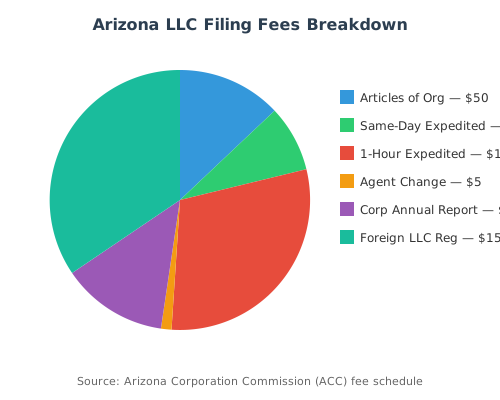
Arizona's fee structure for statutory agent-related filings is notably straightforward. The state does not impose annual report requirements on LLCs, which means the only ongoing compliance cost directly tied to the ACC is maintaining a valid statutory agent. The table below summarizes the key filing fees that Arizona business owners should be aware of when managing their statutory agent appointment.
| Filing Type | Fee | Notes |
|---|---|---|
| Articles of Organization (LLC) | $50 | Includes initial agent appointment |
| Statement of Change of Statutory Agent | $5 | Online or mail filing |
| Articles of Incorporation (Corporation) | $60 | Same agent designation requirements |
| Foreign LLC Registration | $150 | Must designate AZ statutory agent |
| Annual Report (LLCs) | $0 | Not required in Arizona |
| Annual Report (Corporations) | $45 | Due on formation anniversary |
Choosing Wisely: Self-Appointment vs Professional Service
Arizona law allows any individual with a physical address in the state to serve as a statutory agent, and many sole proprietors appoint themselves to save money. However, professional statutory agent services offer several advantages that become more valuable as a business grows: they keep your personal home address off the public record, they guarantee availability during business hours even when you travel, and they provide a reliable system for forwarding legal documents. For businesses with multiple members or those whose owners travel frequently, a professional service can prevent missed deadlines that might lead to default judgments. Whether you call it a statutory agent or a registered agent, the bottom line is the same — Arizona law requires your LLC to have one, and keeping that appointment current with the ACC is a non-negotiable compliance obligation.